

Great Lakes Investment Group
April 05, 2021
Money Wellness Education Financial literacy Economy Lifestyle Monthly commentary News


Cash Flow and Income
At the very beginning of the planning process, we take the time to fully understand your needs for income now and plan for your needs in the future. In this case, we use the general term income, as it represents new monies coming into your portfolio that is generated from both inside and outside the portfolio. This could be actual income from activities you are undertaking personally, like employment, or it could be income in the form of interest or dividends spun off the securities themselves. In either case, this income is new to you and its introduction results in positive contribution to your overall situation.
Historically, we have found that many investors that were accustomed to investing in traditional fixed securities like GIC’s, Canadian Savings Bonds, Corporate Bonds and Government Bonds didn’t fully grasp the difference between types of income streams and often think of them all as the “interest rate or coupon rate” of the securities themselves. These investors are typically from an older generation, where the prevailing interest rates were far higher than they are today, allowing them to purchase very low risk investments with, in today’s terms, very attractive rates of interest income.
If we look at the chart below, from the end of the 1985 to the present, it’s clear to see that the overall trend has been on the decline. If we went back a little further, we would see that the rates peaked about 4 years before that and have been going down ever since.
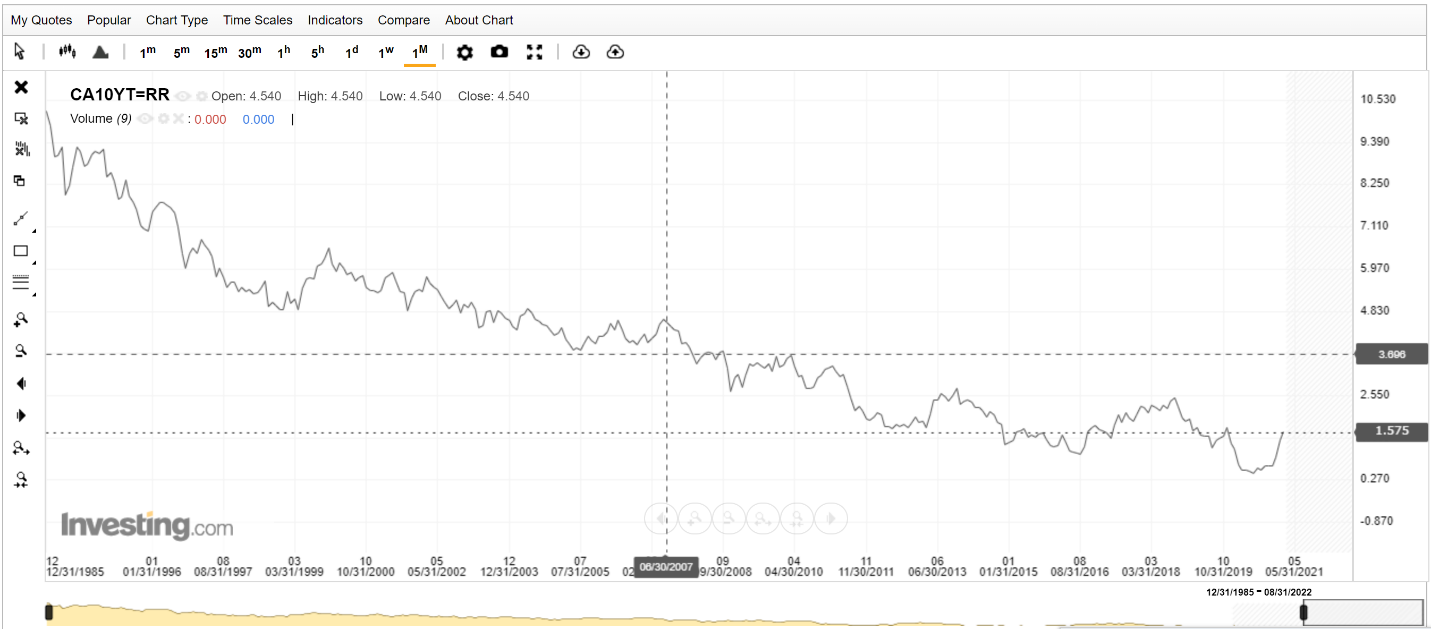
So where does that leave us now and how does it pertain to this discussion? To generations of investors, who were easily able to get relatively “risk free” rates of 5% and above, things have changed. Ironically, human behaviour seems to always goalpost its experiences on the peaks of the past rather than the reality of the current and 8%-10% just isn’t in the cards these days unless you are doing something different. Herein lies the dilemma.
Many investors, in the quest for these higher rates, confuse the difference between interest income, dividend income and return of capital. Talking someone through the interest income vs dividend income concept isn’t terribly difficult because most folks understand the concept that holding equities isn’t the same as holding fixed income. The dividend tax credit is also something that investors will latch onto and helps drive the difference home.
Where we’ve seen the most confusion is from the introduction of Return of Capital (ROC) option to the marketplace. Investment companies are nothing if not resourceful and when they perceived a gap in the market where Canadians wanted to have consistent cash flow but were unable to achieve it from their traditional sources, they created the Return Of Capital (ROC) concept. These investments return a portion of your original invested capital on a regular basis in the form of a non-taxable payment.
There are several interesting components to the ROC class of investments which may or may not be appropriate for your Financials. The marketing of ROC investments often plays on the allure of the posted rate as a means of garnering attention. However, it is precisely these numbers that lead to the confusion for some investors. When the ROC investment states that it pays out 5% or 8% monthly, it is important to note that this cash flow will more than likely be comprised partially or entirely from ROC depending on the investment itself and does not depict a level of interest income that the underlying investment will be delivering. As always, we’re happy to chat with you about this type of income in further detail.
This group of investments brings about the opportunity to do some interesting planning and can potentially play a role in delivering a consistent level of cash flow into your Financial Blueprint. It doesn’t, however, deliver a magical gateway to the higher interest rates of the past. If you are interested in exploring how we achieve your needed level of income, we are more than happy to sit down to discuss the attributes of this class of investments. Hopefully this article will help clarify that all cash flow coming from investments isn’t interest or dividend income and that looking past the posted marketing to understand what exactly is being offered can be very beneficial. At Great Lakes Investment Group, we are here to help you understand what’s available and to help you select the most appropriate vehicles to satisfy your income needs.
Related posts
Great Lakes Investment Group
December 16, 2022
Should My Retirement Plan Use An IPP or RSP?
When it comes to retirement planning, an Individual Pension Plan (IPP) is relatively unknown to most common investors. Historically, most IPP users are business owners, but the benefits of this strate...
Read moreGreat Lakes Investment Group
December 05, 2023
Have High-Interest Savings Accounts Lost Their Value?
On Oct. 31, 2023, the Office of the Superintendent of Financial Institutions (OSFI) announced changes in the liquidity requirements for HISA (High-Interest Savings Account) ETFs that may affect the ra...
Read more